
Black Mold and Stachybotrys in Gainesville, FL: What It Really Is and What to Do
Say “black mold” in Florida and everybody pictures the same horror story. A dark patch on the bathroom ceiling, a Google search at midnight and a lot of words like “toxic” and “deadly.” Take a breath. Most of what you read is louder than the evidence.
Here is the plain version, from a mold removal crew. Stachybotrys chartarum is a real species and it is the one people mean when they say black mold. It grows slowly, needs a lot of sustained moisture and loves paper-faced drywall, ceiling tile and wet insulation. The CDC says all molds should be treated the same, so the real job is the same either way: find the water, remove what the mold has taken and fix the cause. And if you do find it, the useful message is not “panic.” It is “this spot has been wet for a while.”
- The CDC says treat all molds the same
- Needs sustained wetness, 48+ hours
- Color alone cannot name it
- Fix the water first
Checked against CDC, EPA and NIOSH guidance, October 2026.

What Is Stachybotrys, and Is It the Same as Black Mold?
Stachybotrys chartarum (also called Stachybotrys atra) is one specific greenish-black mold. “Black mold” is a loose nickname that people stick on any dark mold, and thousands of different molds look dark. Stachybotrys is the one that got singled out.
When it is actively growing it often looks wet or slimy, not fuzzy, because its spores sit in a sticky mass. As it dries it turns darker, powdery and sooty. It feeds on cellulose, the plant fiber in the paper face of drywall, ceiling tile, fiberboard, wood, cardboard, dust and lint. The CDC describes it as a mold that needs continuous dampness from leaks, condensation, water infiltration or flooding.
- Greenish-black, slimy when wet, powdery when dry
- Grows on paper, drywall, ceiling tile, wood and wet insulation
- Needs steady moisture, not a one-time splash
- Often found only after a long-term leak
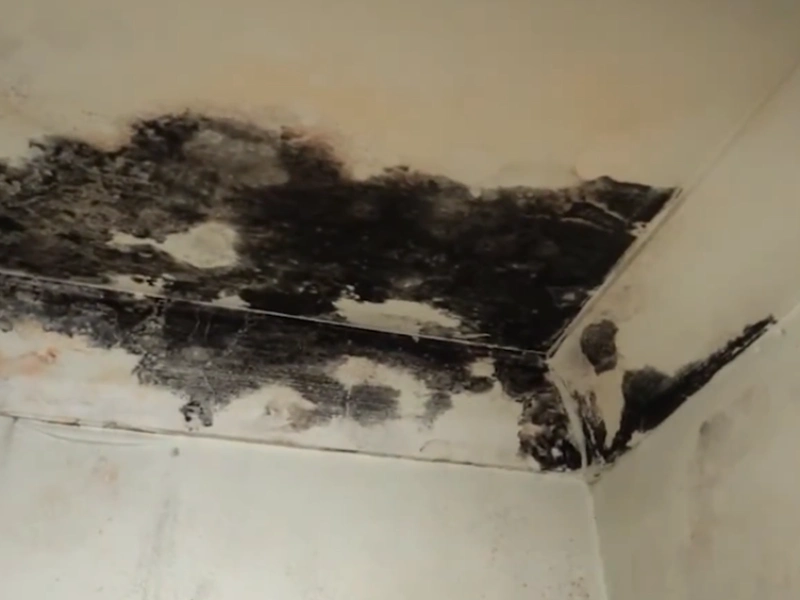
Greenish-black and slimy when growing.
Is “Toxic Black Mold” a Real Thing?
Not in the way the headlines mean it. Some Stachybotrys strains can make mycotoxins, but about one third of them make the harmful trichothecenes, and the CDC says a link to severe illness has not been proven. “Toxic mold” is a media nickname. The mold is not a poison, and treating it like a bioweapon helps nobody.
| The claim you hear | What the evidence says | Rating |
|---|---|---|
| It can produce mycotoxins | True for some strains. Only about one third of S. chartarum isolates make the toxic macrocyclic trichothecenes (Quebec public health). | Supported |
| It is more dangerous than other molds | Cleveland Clinic says black mold is not any more dangerous than other molds. The CDC says all molds should be treated the same. | Not supported |
| It caused infant lung bleeding | The CDC says a possible association with infant acute idiopathic pulmonary hemorrhage has not been proven. | Unproven |
| A test can prove your symptoms come from it | The CDC says no test proves an association between Stachybotrys and particular symptoms. | Not supported |
| Urine “mycotoxin” tests show mold poisoning | AAAAI says these tests are not standardized and cannot be relied on. | Not supported |
| It causes nonspecific symptoms like other molds | The CDC says symptoms are nonspecific and can look like other molds or a cold. | Supported |
If you remember the 1990s scare, the Cleveland infant cases were first linked to Stachybotrys, and a CDC review in 2000 found insufficient evidence of a relationship (as summarized by the AAAAI). The mold did not change. The story did. For a wider look at symptoms, see our guide to mold allergies and health effects, and the CDC’s own Stachybotrys fact page.
What Does Stachybotrys Do to Your Health?
For most people, the same as any damp-building mold: sneezing, a stuffy nose, a cough, a sore throat, itchy red eyes or a skin rash. It can trigger or worsen asthma. Some people notice nothing at all. It rarely causes serious illness in healthy people, according to Cleveland Clinic.
| Who | What to expect | What to do |
|---|---|---|
| Most healthy adults | Mild allergy or irritation, or nothing | Fix the moisture and remove the growth |
| Asthma or mold allergy | Wheezing, chest tightness and shortness of breath can flare | See your doctor and keep that person out of the room during cleanup |
| Weak immune system or chronic lung disease | The CDC lists these groups as higher risk | Do not DIY. Ask their doctor first. |
| Anyone who feels better away from home | NIOSH notes asthma symptoms from damp buildings typically improve away from the building | Get checked, then hunt for the moisture |
Doctors can run a skin prick or IgE blood test to look for a mold allergy. Cleveland Clinic notes that there is no scientific evidence behind “mold toxin detox” claims, and treatment is mostly avoiding exposure plus allergy medicine. See a doctor for breathing trouble, fever or symptoms that will not clear.
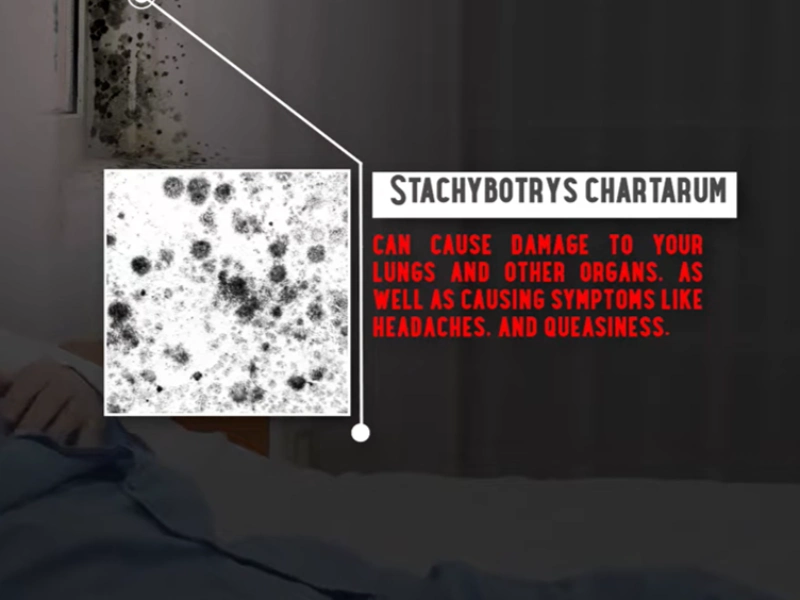
Symptoms follow exposure and ease away from it.
Should You Leave Your Home If You Find Stachybotrys?
Usually not. A small patch you can see, in a house where nobody is sick, is a fix-the-water-and-clean job, not an evacuation. The picture changes when it is large, in or near the AC, tied to flooding, or someone with asthma, a weak immune system or lung disease is having symptoms.
| Your situation | Our honest take |
|---|---|
| One small patch on a hard surface, under about 10 sq ft, nobody has symptoms | Stay. Find the leak, clean with detergent and water, dry it and watch it. |
| Soft, stained or swollen drywall or ceiling tile | Stay if you are well, but do not scrub it. The wet material has to come out. Call for help. |
| Growth near the AC, air handler or vents | Turn the system off if you can, and call. The system can move spores around the house. |
| Flooding or a long roof leak | Treat it as water damage first. Dry or remove wet material within 24 to 48 hours. |
| Someone with asthma, a weak immune system or lung disease, and symptoms | Have that person stay somewhere else until the area is dealt with, and call their doctor. |
This is our field judgment based on CDC and EPA guidance, not medical advice. If anyone has trouble breathing, call a doctor or emergency services.
How Can You Tell If It Is Stachybotrys or Just Black Mold?
You cannot be sure without a lab, and the CDC says you do not need to be. Many molds look dark. A greenish-black, slimy growth on the paper face of wet drywall is a clue, not proof.
| Clue | Stachybotrys tends to | Other dark molds |
|---|---|---|
| Texture | Wet or slimy when active, powdery and sooty when dry | Fuzzy, velvety or spotty |
| Color | Greenish-black | Black, brown, gray, green, many shades |
| What it is on | Cellulose: drywall paper, ceiling tile, wood, cardboard | Almost anything damp |
| Speed | Slow. A developed colony suggests long-term wetness | Often quick on a fresh spill |
| Smell | Musty, but not a reliable identifier | Musty |
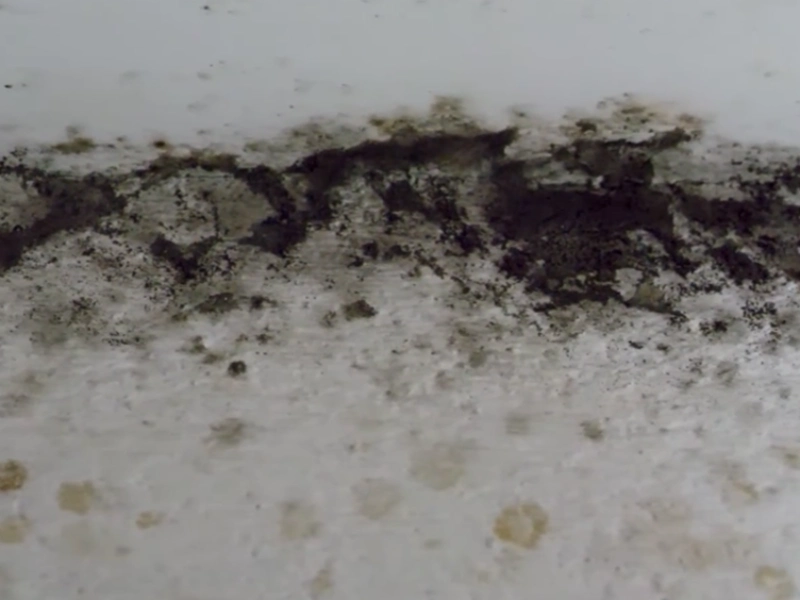
Texture and material give clues, not proof.
Why Does Stachybotrys Grow, and Why Only on Some Walls?
Because it is picky. It is a slow, late arrival that needs a lot of sustained moisture and a cellulose food source. A quick splash that dries within a day will not do it, a slow leak behind a wall that stays wet for weeks might.
1. Water gets in
A roof leak, a supply line, a window that sweats or a backed up AC drain.
2. Early molds arrive
Fast species like Penicillium, Aspergillus and Cladosporium usually move in first.
3. It stays wet
Stachybotrys needs at least 48 hours of sustained wetness to germinate (Quebec public health).
4. Food is on the menu
Paper face of drywall, ceiling tile, fiberboard, wood, cardboard.
5. A slow colony forms
Slimy and greenish-black, with spores held in a sticky mass.
6. Dry and disturbed
When a dried colony is scraped, sanded or knocked, spores can go airborne.
| It needs | The detail | Why it matters in Gainesville |
|---|---|---|
| Very wet material | Water activity of at least 0.94, best above 0.98 | A damp feeling is not enough. Soaked drywall or a leaking pipe is. |
| Time | Slower than most molds | A mature colony means the leak is old. |
| Comfortable temperature | 2 to 40 C, best at about 23 to 27 C (roughly 73 to 81 F) | Typical indoor temperatures in an air-conditioned Gainesville home sit inside its sweet spot. |
| Cellulose food | Paper, drywall facing, wood, ceiling tile | Most Florida homes have plenty of it. |
Does Stachybotrys Spread, and Can You Smell It?
It does not spread like wildfire. Its spores sit in a sticky mass and mostly stay put until the colony dries out, turns brittle and gets disturbed. You may notice a musty smell, but that is true of any hidden mold and it does not tell you which one it is.
That behavior is the reason to be gentle with it. Dry scrubbing, sanding or ripping out a dried patch is exactly what throws spores into the air. It is also why we use containment and keep the air moving through filters when a job is bigger than a small spot. If you smell something musty and cannot find a source, it is usually a hidden wet spot behind a wall, under flooring or in the AC closet, not a reason to pick the wall apart yourself.
Where Is Stachybotrys Most Often Found in Gainesville Homes?
| Spot | Why it happens | Next step |
|---|---|---|
| Drywall behind a leaking shower, tub or supply line | Constant moisture on paper-faced board | Find the leak, open the wall, dry or replace |
| Ceiling drywall or tile under a roof leak | Storms and old flashing | Fix the roof first. See water damage restoration. |
| Back of cabinets under sinks | Slow drips on particleboard and paper | Repair the line, replace what is soft |
| AC closet and air handler platform | Condensate line backing up | Clear the drain. See AC and duct mold. |
| Attic sheathing and insulation | Hot humid air meeting cooler surfaces | See attic mold |
| Crawl space joists and subfloor | Wet ground and humid air | See crawl space mold |
Why Does Gainesville Make Black Mold More Likely?
The air does half the work. Gainesville sits in a warm, humid subtropical climate. Humidity averages around 71 percent and runs near 80 percent in August, the wettest stretch is June through August and the AC runs most of the year. Add an indoor temperature that sits right inside Stachybotrys’s comfort zone and one hidden leak is all it needs. In Florida, a lot of people just say “black mold” for anything dark and fuzzy. Fair enough, as long as nobody panics or paints over it.
Where does your indoor humidity land?
EPA range: 30 to 60%. Cleveland Clinic says 30 to 50% is better and the CDC says under 50%. A cheap hygrometer beats a guess.
| Gainesville season | What happens | What it does to black mold risk |
|---|---|---|
| June to August | Wettest months, humidity near 80% in August | Condensation and slow leaks keep material wet long enough for slow molds |
| June 1 to November 30 | Atlantic hurricane season, still running in October | Roof leaks and wet insulation. Dry or remove within 24 to 48 hours. |
| Cooler months | The AC runs less | Less moisture removal, so closets and bathrooms can stay damp |
What Do Suspected Black Mold Calls Look Like Around Gainesville?
Illustrative scenarios based on common patterns, not specific customers.
| Scenario | What sets it up | What we usually find | First move |
|---|---|---|---|
| Rental near UF and Midtown (32601 or 32603) | A bathroom fan that barely moves air and a shower leak into the wall | Dark growth on the back of the drywall, flat staining on the front | Photograph it, written notice to the landlord, stop using that shower if it leaks |
| Two-story home in Haile Plantation (32608) | A shower pan or supply line leaking into the ceiling below | Soft, stained ceiling drywall with greenish-black growth above | Find the leak, open the ceiling, dry it, replace what is soft |
| Pier-and-post house near Paynes Prairie (32641) | Humid air and wet ground under the house | Growth on joists and subfloor, musty smell in floor-level rooms | Look underneath. See crawl space mold |
| Apartment near Butler Plaza or Archer Road (32608) | A condensate line that backs up into the AC closet | Wet carpet pad and closet drywall | Clear the line, dry within 24 to 48 hours |
| Older house in the Duckpond area (32601) | Aging flashing, windows or plumbing letting water in slowly | Stained ceiling tile or plaster, damp for months | Fix the source before any cleaning |
| Northeast Gainesville home near Newnans Lake (32609) | A heavy afternoon storm and a roof leak over the attic | Wet insulation and dark sheathing | See attic mold and dry fast |
We work across 32601, 32603, 32605, 32606, 32607, 32608, 32609 and 32641, plus High Springs, Alachua, Newberry, Archer and Micanopy.
What Kills Stachybotrys, and Can You Clean It Yourself?
Often yes, if it is small. On a hard surface under about 10 square feet, the EPA’s approach is soap or detergent and water, then drying. Wet drywall, insulation, ceiling tile and carpet pad that have grown mold usually have to be removed, not cleaned. And no, bleach and paint are not the answer.
| Material | Clean or replace? | Why |
|---|---|---|
| Tile, glass, sealed trim, metal | Clean | Hard and non porous. Detergent and water, then dry. |
| Painted drywall, small dry spot | Maybe clean | If it is hard, dry and small. If it is soft, swollen or stained through, cut it out. |
| Wet drywall or plaster with growth | Replace | Mold roots into paper and gypsum. Surface cleaning leaves the rest behind. |
| Insulation and ceiling tile | Replace | Absorbent. The EPA says absorbent materials may need replacing. |
| Carpet and pad | Usually replace | Stays wet and holds growth. The EPA says avoid carpet where it stays damp. |
| Wood framing | Clean and dry, check for softness | Solid wood can often be cleaned. Rot is a separate issue. |
Do
- Fix the water first
- Wear gloves, eye protection and a mask
- Wash hard surfaces with detergent and water, then dry them
- Keep kids, pets and sensitive people out
Do not
- Dry scrub or sand a dried colony
- Mix bleach with ammonia or other cleaners
- Paint over it, even with “mold proof” paint
- Run the AC fan across the area while you work
That “mold proof paint, and it grows back” story is one we hear from renters and homeowners all the time. Paint covers the stain, not the moisture behind it. The EPA does not recommend routine biocides like bleach, and a stronger product does not fix a wet wall.
Do You Need a Mold Test to Know It Is Stachybotrys?
Usually not. The CDC says it is not necessary to determine what type of mold is growing indoors, because all molds should be treated the same. A lab result changes the name on the report, not the plan: find the water, remove what is affected and dry it.
| Test | What it can tell you | What it cannot |
|---|---|---|
| Lab identification of a sample | Which species is present | Whether it is making your symptoms or how wet the wall is |
| Air sample | A snapshot of spores in the air that day | Where the moisture is. A colony that is slimy and wet may shed few spores, so an air sample can miss it. |
| Home test kit | That mold spores exist, which they do everywhere | Anything useful. Kits are unreliable. |
| Skin prick or IgE blood test (doctor) | Whether you are allergic to mold | Whether Stachybotrys is the cause |
| Urine mycotoxin test | Nothing reliable (AAAAI says they are not standardized) | Mold poisoning |
If you already have an air test that came back positive, you know what to do: find the source of the moisture and deal with it. If you want a second look at a report, send it to us along with photos.
What If You Reported the Leak and Nobody Came?
Keep a paper trail. A rental with a known leak for months and now visible growth is a common, frustrating situation. The building fix is the same, but who pays and who acts is a legal question.
- Photograph the leak, the stain and the growth with dates
- Send written notice by email or letter and keep a copy
- Ask for the cause repaired (roof, plumbing, AC drain), not only the stain wiped
- Keep records of any symptoms and doctor visits
Florida’s landlord maintenance statute, 83.51, covers the landlord’s duty to keep plumbing and structural parts in good repair. We are not lawyers, so for your rights and remedies talk to one or to legal aid. Our part is the building side: find the water, document what we see and fix it correctly.
When Should You Stop and Call Someone?
Reasonable to handle yourself
- Under about 10 square feet on a hard surface
- A leak you found, stopped and can fully see
- No one at home has asthma, allergies or a weak immune system
Time to bring in help
- More than about 10 contiguous square feet, or it keeps coming back
- Growth in or around the AC, ducts or air handler
- Soft, swollen or stained drywall, wet insulation or water older than 48 hours
- Someone at home is sensitive, or you smell mold but cannot find it
This is where Gainesville Mold Rescue comes in. We look at it, find the water, set up containment, remove what the mold has taken and dry the area, then explain what caused it. You can read our step by step process and our page on black mold removal in Gainesville. If water is still coming in after a storm, start with emergency mold removal.
How Do You Keep Black Mold From Coming Back?
| Habit | Why it works | Gainesville note |
|---|---|---|
| Fix leaks immediately and dry wet material in 24 to 48 hours | Stachybotrys needs sustained wetness. Shortening the wet time starves it. | After a storm, check ceilings and the attic first. |
| Keep humidity under 60%, closer to 50% | The EPA range is 30 to 60% | A hygrometer is a few dollars. August outdoor air alone can push a closed house over the line. |
| Keep the AC drain clear and the system serviced | The AC removes moisture and a clogged line puts it back | A backed up condensate line is a common local culprit. |
| Run bathroom and kitchen fans | Takes steam out before it condenses on walls | A fan that barely moves a tissue is not doing the job. |
| Replace, do not dry, soaked drywall, ceiling tile and insulation | Wet absorbent material is the food source | If it sat wet more than 48 hours, plan to replace it. |
Our full guide has humidity targets, AC checks and a post-storm routine: mold prevention tips for Gainesville homes. If you are not sure whether what you see is mold or something flatter, read mold vs mildew.
Found Something Dark and Not Sure What To Do?
Call Gainesville Mold Rescue. Tell us where it is, what it is growing on, whether there was a leak or a storm and whether anyone has symptoms, and we will tell you what to do next. Photos of the area help.
Black Mold and Stachybotrys Questions, Answered Honestly
What is Stachybotrys?
Stachybotrys chartarum, also called Stachybotrys atra, is a greenish-black mold that grows on cellulose-rich material like the paper face of drywall, ceiling tile, fiberboard and wood. It needs continuous dampness from leaks, condensation or flooding (CDC).
Is Stachybotrys the same as black mold?
Stachybotrys is the species most people mean by black mold, but the nickname is used for any dark mold. Many unrelated molds look black or dark green, so color alone cannot tell you which one you have.
Is Stachybotrys mold harmful?
It can cause the same allergy and irritation symptoms as other molds: sneezing, cough, stuffy nose, itchy eyes, and asthma flares. Cleveland Clinic says black mold is not any more dangerous than other molds, and the CDC says to treat all molds the same.
Is toxic black mold real?
Some Stachybotrys strains can make mycotoxins, but only about one third make the harmful trichothecenes, and the CDC says an association with severe illness such as infant lung bleeding has not been proven. “Toxic black mold” is a media nickname, not a medical diagnosis.
Should I leave my home if I find Stachybotrys?
Usually not for a small patch when nobody is sick. Fix the water and clean or remove the growth. Consider staying elsewhere if growth is large, near the AC or tied to flooding, or if someone with asthma, a weak immune system or lung disease has symptoms. Check with their doctor.
What is the deadliest black mold?
There is no scientifically ranked deadliest black mold in homes. The CDC says all molds should be treated the same regarding health risks and removal. Online claims about a deadly species go further than the evidence.
Can you smell Stachybotrys?
Hidden mold often gives off a musty smell, but that is true of many molds and it does not identify Stachybotrys. A musty smell with no visible source usually means a hidden wet spot, such as behind a wall or in the AC closet.
How can I tell if mold is Stachybotrys?
You cannot be sure without a lab. Clues are greenish-black color, a slimy look when wet and sooty look when dry, and growth on paper, drywall, ceiling tile or wood after long-term wetness. The CDC says you do not need to identify the species to deal with it.
What kills Stachybotrys?
On hard surfaces, soap or detergent and water plus thorough drying removes it, per EPA guidance. The EPA does not recommend routine biocides like bleach. Porous materials such as wet drywall, insulation and ceiling tile usually have to be removed, and the moisture source must be fixed.
Can I clean black mold myself?
Often yes, if it is under about 10 square feet on a hard surface and no one in the home is sensitive. Wear gloves, eye protection and a mask, and do not dry scrub or sand it. Larger areas, soft drywall, wet insulation or growth near the AC are better handled by professionals.
Does black mold spread through the air?
Not easily while it is wet. Stachybotrys spores sit in a sticky mass. They are released mainly when a dried colony is disturbed, which is why scraping or sanding a dry patch is a bad idea.
How long does it take for Stachybotrys to grow?
It needs at least 48 hours of sustained wetness to germinate and then grows slowly compared to many molds. A well developed colony usually means the area has been wet for a long time, not just since last week.
What happens if you sleep in a room with black mold?
Some people get allergy or irritation symptoms like a stuffy nose, cough or wheezing, especially with asthma, and others notice nothing. If symptoms ease when you are away from home, see a doctor and look for the moisture source.
Can I paint over black mold?
No. Paint hides the stain but not the moisture or the growth underneath, so it usually returns even with mold resistant paint. Fix the water, remove or clean the growth properly and only paint dry, clean surfaces.
Do I need a mold test to confirm Stachybotrys?
Usually not. The CDC says it is not necessary to determine what type of mold is present, and no test proves your symptoms come from Stachybotrys. Fixing the water and removing the growth is the plan either way.
Do you serve my part of Gainesville?
Yes. We cover 32601, 32603, 32605, 32606, 32607, 32608, 32609 and 32641, plus High Springs, Alachua, Newberry, Archer and Micanopy. Call (352) 450-4030 and we will confirm your address.
Sources
- CDC: Facts About Stachybotrys chartarum
- CDC NIOSH: Health Problems From Mold in Damp Buildings
- U.S. EPA: Ten Things You Should Know About Mold
- U.S. EPA: How do molds affect people?
- Cleveland Clinic: Black Mold Exposure
- Institut national de sante publique du Quebec: Stachybotrys chartarum
- AAAAI: Toxic Mold Syndrome, Separating Fact from Fiction
- Florida Statute 83.51: Landlord obligation to maintain premises