
Mold vs Mildew in Gainesville, FL: How to Tell the Difference and What to Do About It
You found a gray, fuzzy or powdery patch on the shower ceiling, a closet wall or a window sill, and now you are stuck on one word. Is it mold or mildew? Is this a scrub-it-and-forget-it job or a call-someone job? In Gainesville, where the air sits close to 80 percent humidity in August, sooner or later you will see one or the other.
Here is the plain version, from a mold removal crew. Mildew is a name for certain molds that grow flat on a surface, so every mildew is a mold, but not every mold is mildew. The word matters less than three questions: how big is it, what is it growing on and why is that spot wet? And no, you usually cannot tell by color or smell. We will show you what to do instead.
- Mildew is a kind of surface mold (EPA)
- Color and smell do not prove which it is
- Dry wet material in 24 to 48 hours
- About 10 square feet is the DIY line
Checked against EPA, CDC and NIOSH guidance, October 2026.
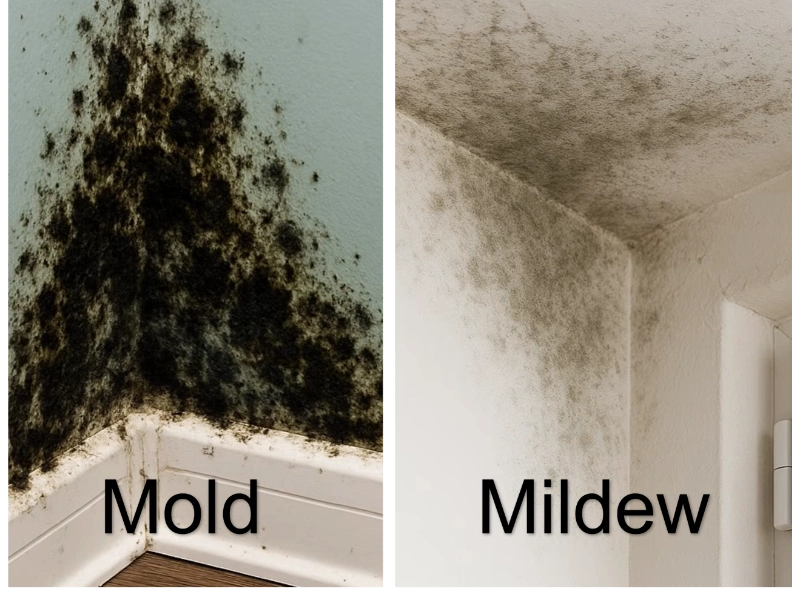
What Is the Difference Between Mold and Mildew?
Mildew is the name people, and the EPA, use for certain molds that grow flat on a damp surface like a shower wall or window sill. Mold is the bigger family, and it also covers fuzzy, raised and deeper growth. So mildew is a kind of mold, not a separate enemy.
The EPA puts it in one line: mildew refers to certain kinds of mold or fungus, and the word is often used loosely for mold with a flat look. Molds are microscopic fungi that grow as tiny threads, feed on organic material such as wood, paper, fabric and the paper face of drywall, and need moisture to do it. The EPA also notes that mildew tends to show up where moisture is high, like shower walls and window sills.
There is one more wrinkle. Botanists use “mildew” for powdery and downy mildew, which are plant diseases that live on leaves. A building-science writer who studies fungi in houses points out that almost everything called mildew indoors is really an ordinary mold. That is why your landlord, your contractor and the internet all use the two words differently. For the record, the EPA’s answer is the one to trust.
How Can You Tell Mold From Mildew?
Look at texture, spread and what it is sitting on. Mildew usually looks flat, powdery or downy and white, gray or yellowish. Mold usually looks fuzzy, raised or slimy and can be green, black, brown, blue, orange or even white. Treat this as a first guess, not a lab result, because color and smell prove very little.
| Clue | Mildew (usually) | Mold (usually) | How much to trust it |
|---|---|---|---|
| Texture | Flat, powdery or downy | Fuzzy, raised, slimy or patchy | Useful |
| Color | White, gray or yellowish, can darken to brown | Green, black, brown, blue, orange, also white | Unreliable |
| How it spreads | Thin film across a hard surface | Can grow into porous material like drywall paper, wood and ceiling tile | Sometimes |
| Smell | Damp, stale | Musty, sometimes sharper | Unreliable |
| Where | Shower walls, grout, caulk, window sills | Anywhere a steady moisture source exists, including behind walls and in the AC closet | A clue |
| Wipes off? | Often, from a hard surface | Often stains, smears or comes back | Good test |
Honest caveat: a fungus in a building cannot be named by color or smell. White molds exist, black mildew exists and both smell musty. Only a lab can name the species, and the CDC does not recommend routine mold testing, because the plan is the same either way: find the water, dry it, clean or remove what is affected and fix the cause.
What Does Mold Look Like, and What Does Mildew Look Like?
Mold, up close
Mold is the one that looks like it is growing. Raised, fuzzy or slimy patches, spotty clusters, often dark, though not always. It sits where something has stayed wet for days, not minutes: a ceiling under a slow bathroom leak, the back of a closet on an outside corner, drywall under a window that sweats all summer. If you can see it on the surface, there can be more behind it.
- Fuzzy, raised or slimy texture
- Green, black, brown, blue, orange or white
- Often on drywall, wood, ceiling tile or insulation
- Returns after a wipe
Names you may have heard, like Stachybotrys, Aspergillus and Cladosporium, are species of mold, not stages of mildew.
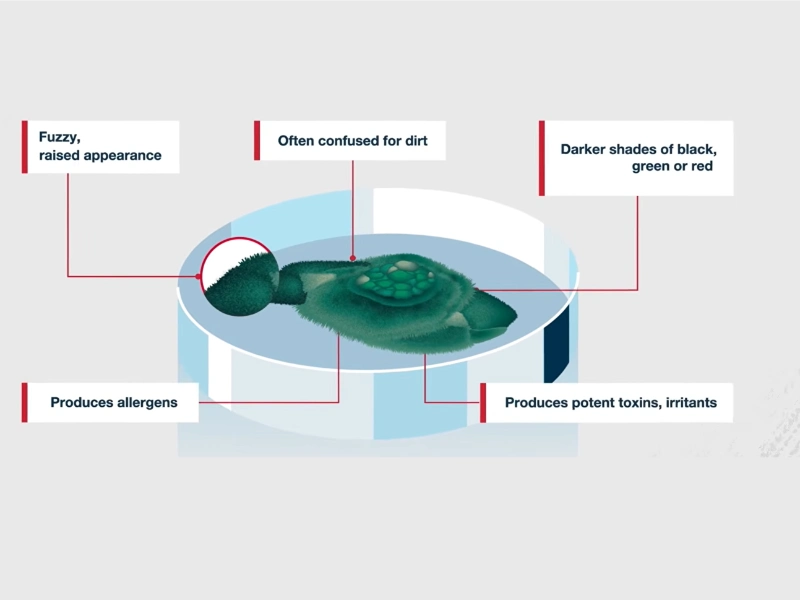
Mold tends to look raised and fuzzy.
Mildew, up close
Mildew is the flat one. A thin gray, white or yellowish film, sometimes powdery, on shower walls, grout lines, window sills and the lip of a tub. It loves a surface that gets wet every day and dries slowly, which in Gainesville means any bathroom with a weak fan or a window that fogs all summer.
- Flat, powdery or downy film
- White, gray or yellowish, may turn brown
- Hard, non porous surfaces like tile, glass and sealed trim
- Often cleans off, then returns if the room stays damp
A bathroom that grows it every month is telling you the ventilation is not keeping up.
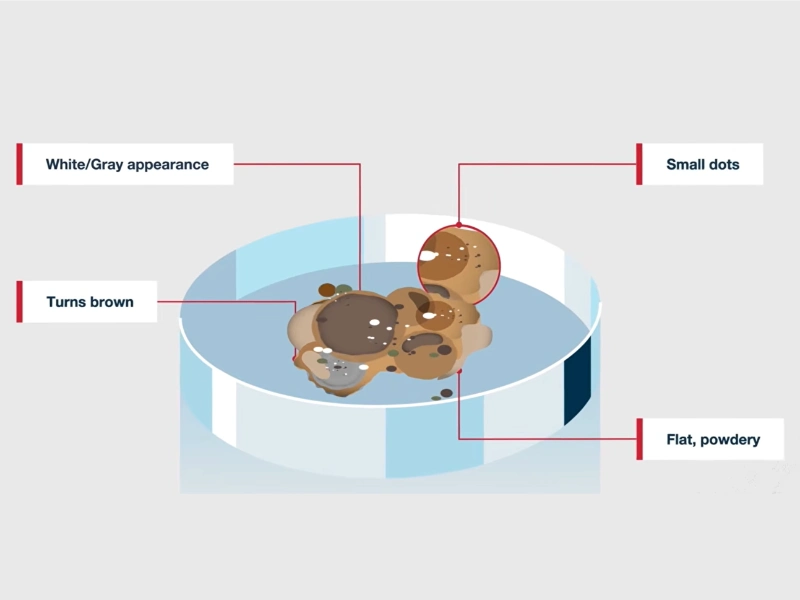
Mildew usually stays flat on the surface.
Is Mildew Just Baby Mold?
No. Mildew is not a growth stage that turns into mold later. It is a name for certain molds with a flat, surface look. The picture does carry one useful truth, though: growth caught early on a hard surface is the easiest to fix.
A popular explainer video calls mildew the infant and mold the adult. It sticks in your head, but it is not how fungi work. What really changes between a thin film and a thick colony is time, moisture and food. Leave a damp spot on drywall paper for a few weeks and it goes from a surface problem to a material problem. Same family, more days wet. That is why we care about the water far more than the label.
Which Is Worse, Mold or Mildew?
Neither is harmless to everyone and neither is automatically an emergency. The EPA says the usual effects are allergic and irritant. What changes the risk is who lives in the house and how much is growing, not which word you use. Bigger, wetter and more hidden is always worse.
| Who is in the home | What mold or mildew can do | What we would do |
|---|---|---|
| Most healthy adults | Sneezing, stuffy or runny nose, itchy eyes, sore throat, cough, sometimes a skin rash. Some people notice nothing at all. | Clean small hard-surface growth and fix the moisture behind it. |
| People with asthma or a mold allergy | Symptoms can flare, and asthma attacks are possible. | Act sooner. Keep them out of the room while you clean and talk to their doctor. |
| Weakened immune system or chronic lung disease | The CDC lists these groups as higher risk for more serious effects. | Do not DIY a patch. Ask their doctor first and get help with the cleanup. |
| Symptoms that ease when you leave the building | NIOSH notes asthma symptoms from damp buildings typically improve away from the building. | See a doctor, then look for the moisture source. |
We go deeper on symptoms in our guide to mold allergies and health effects. The short version: scary black mold stories online run well ahead of the evidence, and a calm, thorough fix beats panic every time. The EPA’s page on how molds affect people is a good plain reference.
Does Mildew Just Wipe Off?
Often, yes, when it is thin and sitting on a hard surface like tile or painted trim. If it smears, stains, soaks into drywall or comes back within a few days, something is still feeding it and the job is bigger than a wipe.
1. Size it
Estimate the area. Under about 10 square feet is the EPA’s small-job range.
2. Check the surface
Tile, glass and sealed trim are hard. Drywall, ceiling tile, carpet and bare wood are porous.
3. Gear up
Gloves, eye protection and a mask. Keep kids, pets and anyone with asthma out of the room.
4. Wash and dry
Soap or detergent and water on a hard surface, then dry it completely (EPA).
5. Watch it
Look again in a few days and after the next rainstorm. If it returns, moisture is still there.
6. Call if it fights back
Soft drywall, a spreading patch or a smell that stays after cleaning means stop wiping.
Steps 5 and 6 are our field rule of thumb, not an EPA rule. Steps 1, 2 and 4 follow EPA guidance.
What Kills Mildew, and Is Bleach the Answer?
On a hard surface, soap or detergent and water plus thorough drying does the job. The EPA does not recommend routine biocides like bleach for mold, and nothing “kills it instantly” in a way that matters if the wall stays wet. Dry the area and fix the source or it comes back.
| What people try | Does it help? | Our take |
|---|---|---|
| Detergent and water | Cleans hard surfaces. This is the EPA approach. | Start here, then dry the spot fully. |
| Bleach and water | Lightens stains. The EPA does not recommend routine biocide use and it does nothing about moisture. | Skip it. Never mix bleach with ammonia or other cleaners, the fumes are dangerous. |
| White vinegar | Often suggested for small mildew spots. | Fine to try on a small hard surface, but it does not dry a wall or fix a leak. |
| Paint or primer over it | Hides the stain. | Covers the stain, not the moisture. If the area stays wet the growth usually returns. |
| Fan, dehumidifier, AC | Not a cleaner, but this is the real fix. | Dry the room and keep humidity in range. |
One thing we hear from renters again and again: “Maintenance wiped it with disinfectant and painted over it.” Sometimes that is exactly right for a thin film. It is not enough if the wall behind it is wet, and we get into that in the renter section below.
Why Do Mold and Mildew Show Up So Often in Gainesville?
Because the air does half the work. Gainesville sits in a warm, humid subtropical climate. Humidity averages around 71 percent and runs near 80 percent in August, the wettest stretch is June through August and the AC runs most of the year. Generic advice says “open the windows to dry the house out.” In July that invites some of the wettest air in North Central Florida indoors.
Where does your indoor humidity land?
EPA range: 30 to 60%. The CDC says under 50% is better. A simple hygrometer tells you more than a guess.
| Gainesville season | What happens | What it does to mold and mildew |
|---|---|---|
| June to August | Wettest months, daily storms, humidity near 80% in August | Shower walls, window sills and AC closets stay damp. Surface growth shows up fast. |
| June 1 to November 30 | Atlantic hurricane season, still running in October | Roof leaks and wet insulation. Dry within 24 to 48 hours or it can move from a surface problem to a hidden one. |
| Cooler months | The AC cycles less | When the AC runs less it pulls less moisture from the air, so bathrooms and closets can stay clammy. |
Where Do Mold and Mildew Hide in a Gainesville Home?
| Spot | What it usually is | Why it happens here | Next move |
|---|---|---|---|
| Shower grout and caulk | Mildew, flat and gray or dark | Daily wetting and slow drying | Wash, dry, re-caulk if it is cracked |
| Bathroom ceiling | Mildew or mold | A weak or undersized fan | Check the fan and run it longer. If the paint bubbles, look above it. |
| Window sills and frames | Mildew from condensation | Cold glass, humid air | Wipe, dry and watch the seal |
| Closet on an outside wall | Mold | Cooler wall, still air, no airflow | Open the door, move boxes off the wall, check for a leak |
| AC closet or air handler | Either, and it matters | Condensate line backing up | Clear the drain, dry fast. See AC and duct mold. |
| Attic | Mold on wood sheathing | Hot, humid air meeting cooler surfaces | See attic mold removal |
| Crawl space | Mold on joists and subfloor | Humid air and bare ground | See crawl space mold |
Mold or Mildew on Wood, Clothes, Grout and Drywall: What Changes?
The surface matters more than the name. A hard, sealed surface can be washed. A porous one holds moisture and growth below what you can see.
| Surface | What is usual | What to do |
|---|---|---|
| Tile, grout, glass, sealed trim | Surface film that wipes off | Detergent and water, dry fully, re-caulk cracked seams |
| Drywall and ceiling tile | Spots on the surface, more behind it if it was wet | Small dry spot on a painted wall: clean and watch. Soft, stained or swollen: it often has to be cut out (EPA says absorbent material may need replacing). |
| Wood framing and trim | Can stain and soften when it stays wet | Dry it, clean the surface, check for softness. Rot is a different problem. |
| Carpet and pad | Hold water and smell | Wet more than 24 to 48 hours? The pad often has to go. The EPA says avoid carpet where it stays damp. |
| Clothes, fabric, leather, paper | Spots and a musty smell | Wash and dry fabric completely. Leather, paper and books are hard to save once growth sets in. |
Can You Tell Mold From Mildew in a Photo?
You can make a decent first guess and never a final call. A photo shows texture and spread, but phone cameras shift color, bathroom lighting lies and a picture cannot show what is wet behind the wall.
We get photos every week and they genuinely help, as long as they show the surroundings. Send three:
- A wide shot that includes the ceiling, fan, vent or AC nearby
- A close shot of the growth with a coin or ruler for scale
- Whatever you think is the water source: a pipe, window, drain or stain
Note any smell, when it started and whether it came back after cleaning. That tells us more than the color does.
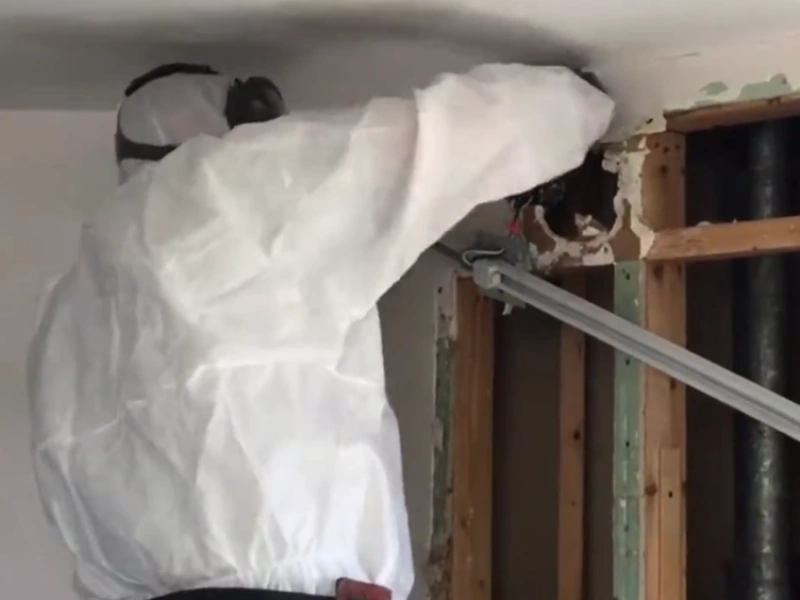
Is it mildew or mold? Context decides.
What Do Gainesville Homes Actually Run Into?
Illustrative scenarios based on common patterns, not specific customers.
| Scenario | What sets it up | Mold or mildew? | First move |
|---|---|---|---|
| Rental near UF and Midtown (32601 or 32603) | Tired AC, windows shut all summer, weak bathroom fan | Mildew on the ceiling, mold if the paint is bubbling | Check the fan and AC drain, tell the landlord in writing |
| Two-story home in Haile Plantation (32608) | Upstairs shower or supply line leaking into the ceiling below | Mold, even if the stain looks flat | Find the leak, open the ceiling, dry it before painting |
| Pier-and-post house near Paynes Prairie (32641) | Humid air under the house, wet crawl space | Mold on joists, musty smell in floor-level rooms | Look underneath. See crawl space mold |
| Apartment near Butler Plaza or Archer Road (32608) | Condensate line backs up into the AC closet | Mold on carpet and the closet wall | Clear the line, dry within 24 to 48 hours |
| Older house in the Duckpond area (32601) | Aging windows, flashing or plumbing letting water in slowly | Mildew on sills that hides slow moisture behind it | Check the source before repainting |
| Northeast Gainesville home near Newnans Lake (32609) | Heavy afternoon storm, a roof leak over the attic | Hidden mold in insulation and sheathing | See attic mold, dry fast |
We work across 32601, 32603, 32605, 32606, 32607, 32608, 32609 and 32641, plus High Springs, Alachua, Newberry, Archer and Micanopy.
What If the Landlord Says It Is Just Mildew?
Sometimes that is correct. A thin film on a shower wall may be exactly that. What it is not is a reason to skip fixing the water. Wiping, a new filter and a coat of paint hide a leak, they do not stop it.
- Photograph it now, wide and close, with the date
- Send written notice by email or letter and keep a copy
- Ask for the cause to be fixed (leak, fan, AC drain), not only the stain
- Note any symptoms and when they started
Florida’s landlord maintenance statute, 83.51, covers the landlord’s duty to keep plumbing and structural parts in good repair. We are not lawyers, so for your rights and options talk to one or to legal aid.
When Should You Stop Wiping and Call Someone?
Reasonable to handle yourself
- A thin film on tile, glass or sealed trim
- Under about 10 square feet on a hard surface
- A leak you found, stopped and can see fully
- No one at home has asthma, allergies or a weak immune system
Time to bring in help
- More than about 10 contiguous square feet, or it keeps coming back
- Growth in or around the AC, ducts or air handler
- Soft, swollen or stained drywall, wet insulation or water older than 48 hours
- Someone at home is sensitive, or you smell mold but cannot find it
This is where Gainesville Mold Rescue comes in. We look at it, tell you straight if it is a wipe-down, and if it is not, we find the water, remove what the mold has taken and fix the cause. Our step by step process is spelled out. After storms or a burst pipe, see water damage restoration. If you see black growth and are worried, our pages on black mold removal and Stachybotrys separate fact from fear.
How Do You Keep Mold and Mildew From Coming Back?
| Habit | Why it works | Gainesville note |
|---|---|---|
| Keep humidity under 60%, closer to 50% | Mold needs moisture. The EPA range is 30 to 60%. | Buy a hygrometer. August outdoor air alone can push a closed house over the line. |
| Run the bathroom fan during and after showers | Removes steam before it settles on grout and ceiling | A fan that barely moves a tissue is not doing the job. |
| Fix leaks and dry spills in 24 to 48 hours | This is the EPA window | After a storm, check the attic and ceilings first. |
| Keep the AC drain clear and the system serviced | The AC removes moisture, and a clogged line returns it | A backed-up condensate line is a common Gainesville culprit. |
| Wipe down shower walls and re-caulk cracks | Takes away the film that mildew starts on | Do it before summer, not after. |
We built a full guide on this: mold prevention tips for Gainesville homes, with humidity targets, AC checks and a post-storm routine.
Not Sure Whether It Is Mold or Mildew?
Call Gainesville Mold Rescue. Tell us where it is, what it is growing on and whether there was a leak or a storm, and we will tell you what to do next. Photos of the area help.
Mold vs Mildew Questions, Answered Honestly
What is the difference between mold and mildew?
Mildew is the name people use for certain molds that grow flat and powdery on a damp surface. Mold is the bigger group and also includes fuzzy, raised and deeper growth. The EPA describes mildew as certain kinds of mold or fungus, so mildew is a type of mold, not a different thing.
Is mildew the same thing as mold?
Close, but not identical in everyday use. Every mildew is a mold, but not every mold is mildew. Outdoors, mildew can also mean a plant disease on leaves. Indoors, it is almost always an ordinary surface mold.
How can you tell if it is mold or mildew?
Check texture, spread and surface. Mildew is usually flat, powdery or downy and white, gray or yellowish. Mold is usually fuzzy, raised or slimy and can be many colors. Color and smell are unreliable, so also ask how big it is, what it is growing on and whether the spot stays wet.
Which is worse, mold or mildew?
Neither is harmless to everyone. The EPA says the usual effects are allergic and irritant. What raises the stakes is a sensitive person in the home (asthma, mold allergy, weak immune system or chronic lung disease, per the CDC) and how large, wet and hidden the growth is.
Does mildew just wipe off?
Often, yes, if it is thin and on a hard surface like tile or sealed trim. Wash with soap or detergent and water, then dry it. If it stains, smears, soaks into drywall or returns within a few days, there is a moisture problem that wiping will not fix.
What kills mildew instantly?
Nothing that matters if the surface stays wet. On a hard surface, detergent and water plus drying removes it. The EPA does not recommend routine biocides for mold. The lasting fix is removing the moisture that feeds it.
Can bleach alone kill mold on a bathroom ceiling?
It may lighten the stain, but it does not dry the ceiling or fix the cause, and the EPA does not recommend routine biocide use. If the paint is bubbling or soft, look for a leak above it. Never mix bleach with ammonia or other cleaners.
Is any house 100 percent mold free?
No. The EPA says it is not practical to eliminate all mold and mold spores indoors. The goal is to control moisture so mold has no chance to grow, mainly by keeping humidity in range and drying leaks fast.
Is mildew dangerous to breathe?
For most people it causes at most mild irritation, like a stuffy nose, cough or itchy eyes. People with asthma, a mold allergy, a weak immune system or chronic lung disease can react more strongly. See a doctor for breathing trouble.
Is black mold the same as mildew?
Not necessarily. Black growth can be a common mold, a darkened mildew or Stachybotrys. Color does not identify it. Treat any black growth by finding the water and cleaning or removing it properly. See our black mold page for the facts.
Do I need a mold test to know which one it is?
Usually not. The CDC does not recommend routine mold testing, and a result does not change the plan: dry the area, clean or remove what is affected and fix the cause. A lab name will not tell you how wet the wall is.
How fast can mold or mildew grow after water damage?
It can start within a day or two. The EPA says to dry or remove wet material within 24 to 48 hours to keep mold from taking hold. In Gainesville humidity that clock matters even more.
Can I paint over mold or mildew?
Paint covers the stain, not the moisture. If the area stays wet, the growth usually returns. Clean small hard-surface spots first, fix the cause and only paint dry, clean surfaces.
How big is too big to clean myself?
The EPA treats up to about 10 square feet as a small area you can often handle on a hard surface. Go to a professional for larger areas, growth in or near the AC, soft or swollen drywall, wet insulation or if someone at home is sensitive.
Why does mildew keep coming back in my bathroom?
Usually because the room stays damp: a weak fan, a missing fan, cracked caulk or a slow leak. Wipe and dry, run the fan longer, re-caulk and check the ceiling above. If it keeps returning, something is still wet.
Do you serve my part of Gainesville?
Yes. We cover 32601, 32603, 32605, 32606, 32607, 32608, 32609 and 32641, plus High Springs, Alachua, Newberry, Archer and Micanopy. Call (352) 450-4030 and we will confirm your address.
Sources
- U.S. EPA: What is the difference between mold and mildew?
- U.S. EPA: Ten Things You Should Know About Mold
- U.S. EPA: How do molds affect people?
- CDC: Mold
- CDC NIOSH: Health Problems From Mold in Damp Buildings
- InspectApedia: Mold in buildings is often mistaken for mildew
- Florida Statute 83.51: Landlord’s obligation to maintain premises