
Commercial Mold Remediation in Gainesville, FL: What Property Managers and Business Owners Need to Know
Ceiling tiles with brown rings, a stock room that smells musty no matter what you do, a wall behind a leaking cooler line. Mold in a building people work, shop, eat or get treated in is a different job than mold in a house. This page explains how it is contained, removed, documented and paid for, so you can make the call with your eyes open.
- Built around EPA commercial-building guidance
- Written scope and photos on every job
- Serving all of Gainesville, FL
Reviewed October 2026 by the Gainesville Mold Rescue team
What Is Commercial Mold Remediation, and How Is It Different From a Home Job?
What changes when the building is not a house?
- More people are exposed. Employees, customers, tenants, patients or students share the air. Mold work has to be sealed off so it never reaches them.
- Systems are shared. One air handler may feed a dozen suites, and a drop ceiling can carry mold from one office to the next above everyone’s head.
- The clock is a business clock. Every day a restaurant or a clinic stays closed hurts, so the job is planned in phases, often after hours.
- Documentation matters more. A lease dispute, an insurance claim or a lender may all ask for proof of what was found, what was removed and how it was verified.
- Square footage is larger. EPA’s commercial guidance steps up the containment and respiratory protection as the affected area grows past 10 and past 100 square feet.
If you want the residential version of the story, our black mold removal page and emergency mold removal guide cover it. This page stays with the building side.
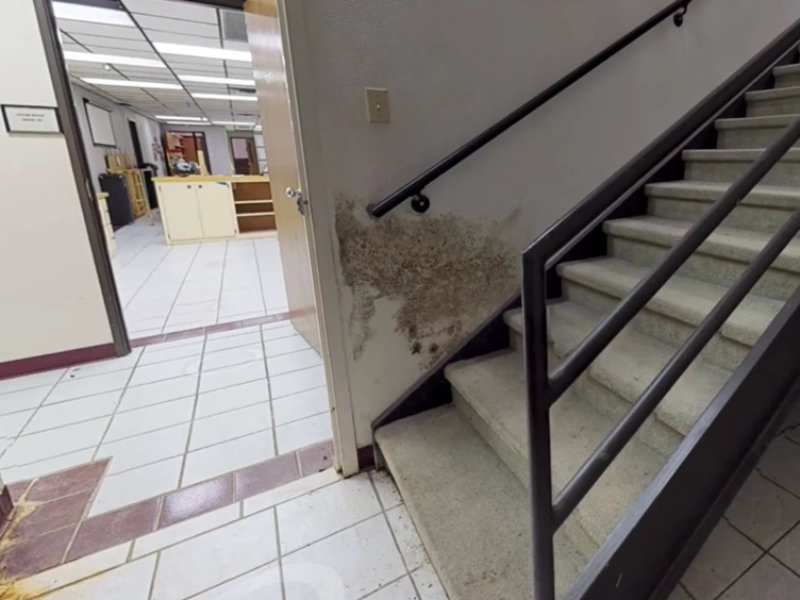
The first look is a moisture map and a photo record, not a guess.
Which Gainesville Properties Need Commercial Mold Remediation?
Gainesville has an unusual mix: a large university, a major hospital district, older downtown buildings, a lot of apartment communities and busy retail corridors. Each one fails in its own way.
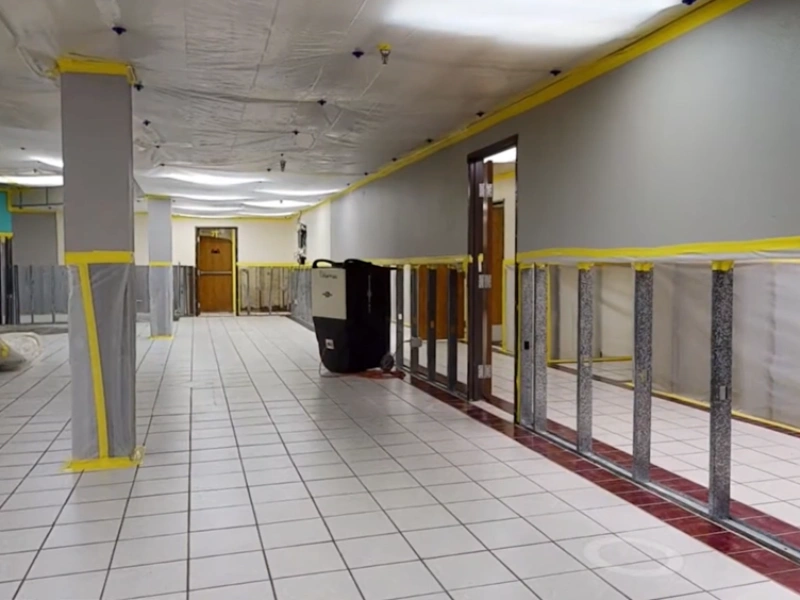
Hidden growth above ceilings is the usual surprise in offices and retail.
Apartments and student housing
Many leases turn over in late summer. Vacant units with the AC set high, a slow condensate line or a leak behind a wall can grow mold in the weeks nobody is home. Work is planned unit by unit.
Offices and retail near Archer Road, Butler Plaza and Midtown
Drop ceilings, rooftop units and ductless mini-splits are the repeat offenders. Growth above the tiles often shows up first as a ceiling stain or a smell.
Restaurants and hospitality
Kitchens, walk-in coolers, dish areas and restrooms run wet all day. Leaks behind equipment and failed seals show up in walls and ceilings.
Medical offices, clinics and senior living
People with weak immune systems or lung conditions are the reason these jobs run on stricter containment and tighter coordination with facility staff.
Schools, churches and warehouses
Large rooms, low-slope roofs and long stretches of closed-up space. Mold often starts at a roof drain, a slab edge or a stored-goods area that never dries.
What Causes Mold in Gainesville Commercial Buildings?
Where does the water come from in a Gainesville building?
- Roofs. Low-slope commercial roofs hold water around drains, seams and rooftop equipment. Summer afternoon storms from June through September test every weak spot.
- HVAC systems. Clogged condensate lines, overflowing drain pans, wet duct insulation and ducts that sweat in humid attics all feed mold. Oversized equipment can cool the air fast without removing much moisture.
- Ductless mini-splits. Units and refrigerant lines above drop ceilings that are not insulated well can drip and chill surfaces until they stay damp. One contractor walkthrough we reviewed traced mold in roughly 15 offices to exactly this.
- Plumbing and equipment lines. A slow leak behind a restroom wall, a cooler line, an ice machine or a dishwasher can stay hidden for months.
- Slab and walls. Moisture moving up through a slab or in through stucco, windows and failed sealant lines wets the lower wall and carpet edge.
- Storm water. Hurricane season runs June 1 to November 30, and a window or roof breach during a storm can soak insulation and ceiling tile in hours.
- Closed-up space. A vacant suite with the AC off or set high through a Gainesville summer is a mold incubator.
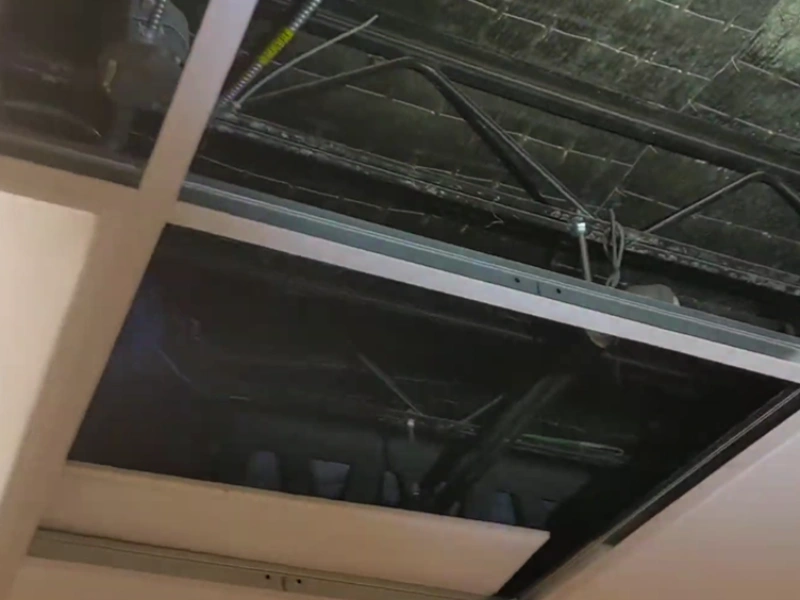
Roof and rooftop-unit leaks are a leading way water gets into commercial ceilings.
When Is Commercial Mold an Emergency, and When Can It Wait?
Mold itself is rarely a same-hour emergency. Active water is. Use this as a quick sort.
| Call today | You can plan the job this week |
|---|---|
| Sewage, flood water or roof water is still coming in | A small, dry stain on a ceiling tile with the leak already fixed |
| Wet materials that have not dried after 24 to 48 hours | Isolated spots well under 10 square feet on a hard surface |
| Visible growth across more than about 10 square feet | A musty smell with no visible growth, no wet materials and no one with symptoms |
| Water or growth at an air handler, duct or ceiling plenum | Cosmetic mildew on grout or caulk in a restroom |
| Hospital, clinic, school, senior living or childcare space | Storage areas that can be closed off and are not shared with the HVAC |
| Tenants or customers are reporting symptoms | Planned renovation work where the area is already open |
If the answer is “call today,” the first move is still the same: stop the water. The emergency mold removal guide walks through the first 24 to 48 hours.
How Does Commercial Mold Remediation Work, Step by Step?
This is the sequence a well-run commercial job follows, built on EPA’s commercial-building guidance and how real jobs are run on site. Details change with the building, but the order does not.
The most important rule is the one people skip: mold that is disturbed without containment spreads. Wiping, scraping, vacuuming or tearing out materials throws spores into the air, which is why the work area gets sealed off and put under negative pressure before anything is removed.
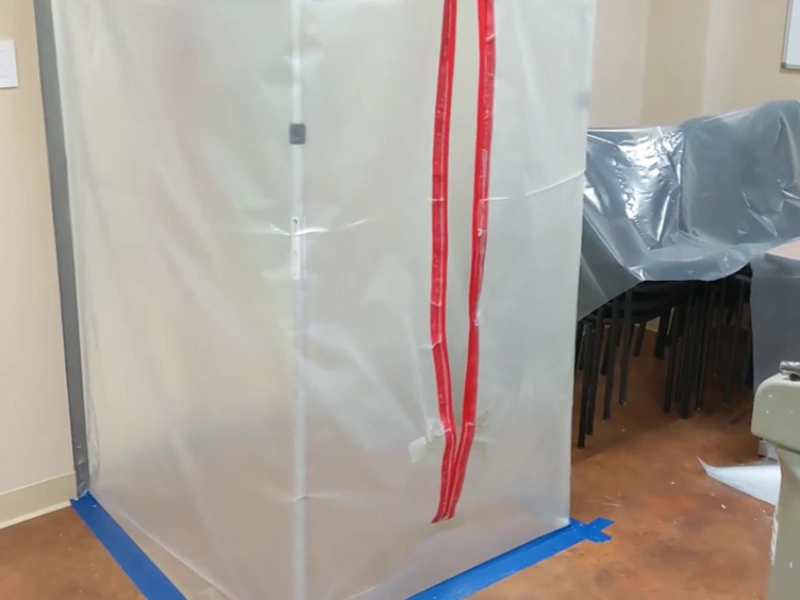
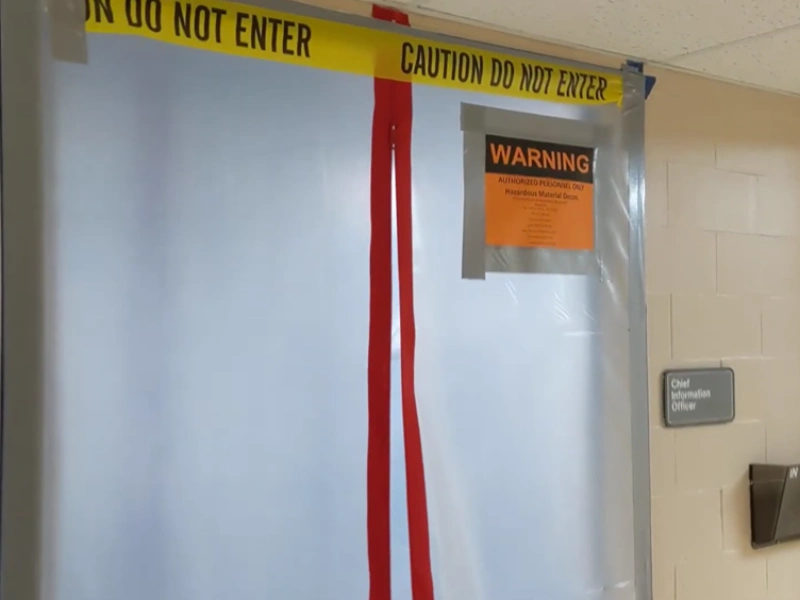
Sealed poly walls, a zipper door and a HEPA machine ducted outside.
Moisture meters and a thermal camera find wet materials, including above ceilings and inside walls. You get photos, readings and a marked-up floor plan of what is affected.
For larger or sensitive jobs, a separate assessor sets the scope and the pass-fail standard before work starts. Florida rules keep the assessor and the remediator apart on the same job, which protects you from a company grading its own work.
The leak, condensation or roof path gets fixed or temporarily controlled, and wet materials are dried or removed. Dehumidifiers and air movers run until readings are back to normal.
Work zones, after-hours windows, foot traffic, elevator and loading access, and HVAC zoning are agreed up front. EPA stresses communicating with occupants, and it saves arguments later.
Poly sheeting, a zippered entry and a decontamination chamber seal the work area. A HEPA air machine exhausts to the outside so air flows into the space, not out of it. Warning signs go on the door.
Crews wear disposable suits, gloves and respirators sized to the job. Ceiling tiles and insulation usually come out first for access. Wet, moldy porous materials like drywall and ceiling tile are removed, bagged and carried out sealed.
Structural surfaces that can be cleaned are HEPA vacuumed and wiped with detergent. EPA’s guidance centers on physically removing mold, not just spraying it.
Workers remove suits in the decon chamber, HEPA vacuum off and clean up before they step back into the occupied building. Nothing walks out dirty.
Containment stays up until the area is visibly clean and moisture is where it should be. Many commercial jobs then use independent clearance testing, with a written result.
Only after removal and drying do new materials go in. Sealers are an option on cleaned surfaces, not a substitute for cleaning. You receive the documentation package described below.
How Much Containment Does a Commercial Mold Job Need?
| Affected area | Containment | Typical protection |
|---|---|---|
| Under 10 sq ft | Minimal or none | N-95 respirator, gloves, eye protection |
| 10 to 100 sq ft | Limited: single-layer 6-mil poly, HEPA-filtered exhaust for negative pressure | Half- or full-face respirator with HEPA cartridges, gloves, disposable clothing |
| Over 100 sq ft | Full: double-layer poly, decon airlock, negative air | Full-face powered air-purifying respirator recommended, full disposable suit |
These tiers come from EPA’s guidance for schools and commercial buildings. The guide itself says to apply professional judgment, so hidden mold or sensitive occupants can justify more protection than the square footage alone suggests.
Can Your Business Stay Open During Mold Remediation?
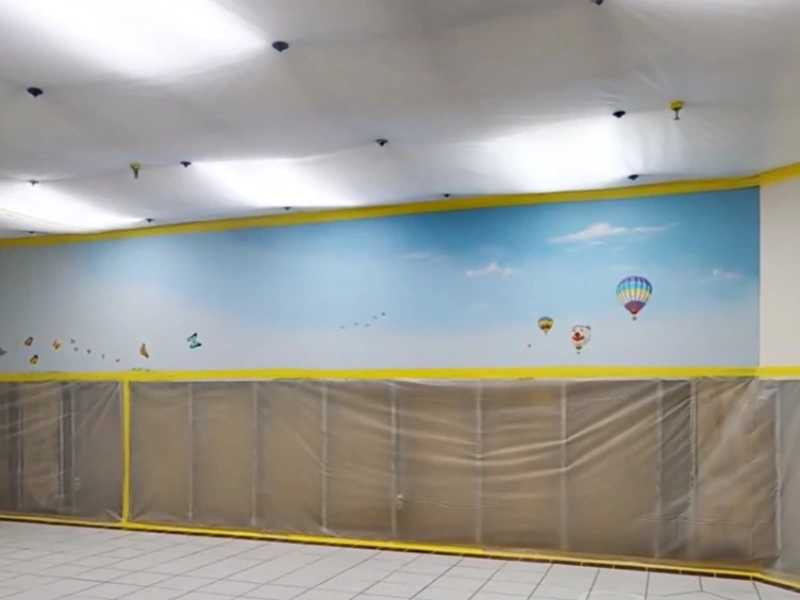
Phasing the work keeps most of a building in use.
What makes a stay-open plan work?
- A hard seal. Poly walls floor to deck, taped and zippered, not a shower curtain across a hallway.
- Negative pressure checked daily. The HEPA machine exhausts outside, and the barrier should pull slightly inward.
- Air handler isolation. Supply and return in the work zone are sealed off so mold cannot ride the ductwork.
- Separate paths. Crews and waste move through a route that avoids customers, patients and lobbies.
- Off-hours for the dusty parts. Tear-out and cleaning happen after close when possible.
- A plain-English notice. Tell staff and tenants what is happening and who to call. Silence breeds rumors and complaints.
What Paperwork Should You Get After Commercial Mold Remediation?
- Written scope or protocol. Areas affected, materials removed, containment level and the standard the job has to meet.
- Before, during and after photos. Dated, labeled by room or suite.
- Moisture readings. Start and finish, so drying is proven and not assumed.
- Containment and negative-air log. Who set it up, when, and daily checks.
- Waste handling note. How removed material left the building.
- Products used. A list of cleaners, sealers or coatings applied, with safety data sheets.
- Clearance result. A written pass from an independent party where one was used.
- Contractor details. Company name, license number where Florida requires one, and a current certificate of insurance.
Who Pays for Commercial Mold Remediation: the Landlord, the Tenant or the Insurer?
What does the lease say?
Look for who maintains the roof, HVAC and plumbing, who handles common areas, how notice has to be given, and whether the landlord can enter. Mold from a roof leak and mold from a tenant’s own equipment can land on different people.
Does commercial property insurance cover mold?
Many policies cover mold that follows a sudden covered loss and limit or exclude mold from long-term leaks or humidity. Ask about mold sublimits and business interruption. Under Florida Statute 627.70132, notice of a new or reopened property claim is generally due within one year of the date of loss, with supplemental claims within 18 months. Commercial policies vary, so read yours.
What if the cause was never fixed?
Carriers and landlords both push back when the leak that caused the mold is still active. Document the repair first and the remediation second.
Can a tenant hire a mold tester without the landlord’s permission?
Nothing we know of in Florida law stops a tenant from hiring one, but your lease may require notice or access terms, and the party who orders the test usually pays for it. An independent assessor’s written findings carry more weight in a dispute than a swab or a photo from a hardware-store kit. Send the landlord written notice with photos either way, and keep a copy.
Can you sue for mold exposure in Florida?
Possibly, depending on the facts: the lease, who knew about the problem, what was done and what harm resulted. Claims can rest on breach of the lease or on negligence, and deadlines can be short. For many negligence claims filed under current Florida law the window is two years. If people have been sick or you have lost property, document everything and speak with a Florida attorney soon. We are not lawyers and this is not legal advice.
How Much Does Commercial Mold Remediation Cost in Gainesville?
| What shapes the job | Why it matters |
|---|---|
| Affected square footage | Bigger areas push you into limited or full containment and more labor. |
| Containment level | Double-layer poly, decon chambers and more negative-air machines take more setup than a simple barrier. |
| What has to come out | Wet ceiling tile and insulation are simple to replace. Wall systems, casework and flooring are not. |
| Access and height | High ceilings, lifts, roofs and tight mechanical spaces slow the work. |
| After-hours or phased work | Keeping the business open usually means nights, weekends and more mobilizations. |
| Drying and water work | Often a separate scope from mold removal. |
| Testing and clearance | Independent assessment and post-work verification are separate line items. |
| Rebuild | Replacing drywall, ceilings and finishes is usually not included in remediation. |
Why do commercial mold quotes vary so much?
Usually because the scopes are not the same. One bid may include containment, clearance and documentation while another leaves them out. Ask every bidder for line items covering containment, removal, cleaning, drying, testing, waste and rebuild, so you are comparing the same job.
What Do Professionals Use for Commercial Mold Remediation?
Containment
6-mil poly sheeting, zipper doors, tape, a decon chamber and HEPA negative-air machines exhausted outside the building.
Personal protection
Disposable suits, gloves, eye protection and respirators matched to the job, from N-95 up to powered air-purifying units for large areas.
Detection and drying
Moisture meters, thermal cameras, hygrometers, dehumidifiers and air movers. Air or surface sampling is used selectively, not as a routine step.
Cleaning
HEPA vacuums and detergent wipe-downs. EPA does not recommend biocides, including bleach, as a routine part of remediation.
Sealers and coatings
Encapsulating sealers can go on cleaned and dried surfaces in some cases. They do not replace removal. See our mold encapsulation page.
Air quality control
HEPA air scrubbers run during and after the work, with filters changed and disposed of properly.
What is the best commercial-grade mold and mildew remover?
No spray replaces removal and drying. Surface cleaners can lighten the look of mildew, but they do not fix a wet wall or ceiling plenum, and EPA’s guidance centers on physically removing mold and fixing moisture. If a product claim sounds like a shortcut around those two steps, treat it that way. For mildew versus mold, see mold vs. mildew.
What Does Florida Law Say About Commercial Mold Remediation?
- No set limits for airborne mold. EPA states there are no federal standards for acceptable mold or spore levels in buildings, and we know of no Florida standard either, so clearance is judged against the protocol and against outdoor or unaffected-area comparisons, not a magic number.
- Florida regulates the professionals. Chapter 468, Part XVI of the Florida Statutes covers mold assessors and mold remediators. Under Section 468.8419, remediation of more than 10 contiguous square feet of mold-like growth generally has to be done by a licensed professional, and an assessor cannot write the protocol and then do the remediation on the same property within 12 months.
- OSHA has no dedicated mold standard. Its general rules on respiratory protection, hazard communication and the general duty to provide a safe workplace still apply to the crews doing the work.
- Leases and insurance policies do most of the heavy lifting. See the section above.
The Florida Department of Health and the University of Florida’s Environmental Health and Safety office both publish practical mold guidance, linked in the sources below.
What Does Commercial Mold Work Look Like at Places Like UF Health Shands and the Florida Museum of Natural History?
How is mold handled near patients at a hospital like UF Health Shands?
UF Health Shands Hospital sits at 1600 SW Archer Road in the 32608 ZIP, in the Archer Road medical corridor. In a hospital, a mold problem is an infection-control problem first. Facilities typically run an infection control risk assessment before any removal or construction near patients, and CDC’s environmental infection control guidelines flag mold such as Aspergillus as a concern for people with weakened immune systems. In practice that means sealed barriers, negative pressure with HEPA exhaust, work scheduled around patient areas, protected paths for waste, and close coordination with facility and infection prevention staff. Speed matters less than control.
What about mold in a museum like the Florida Museum of Natural History?
The Florida Museum of Natural History is on the University of Florida campus in the 32611 ZIP. Collection spaces are normally held to tight temperature and humidity targets, and conservation guidance commonly cites roughly 45 to 55 percent relative humidity, with mold risk climbing when humidity stays above about 65 percent. A remediation crew’s role would be the building: leaking envelope, HVAC, walls, ceiling and storage-room finishes. Mold on specimens or artifacts is a conservator’s job, not a remediation crew’s, and fogging or spraying near collections would need the collections staff’s sign-off.
What does a student housing turnover look like between leases?
Picture a complex off Archer Road or Tower Road in August. A few vacant units were left with the AC high or a slow mini-split drain, and ceiling tiles above the hall show rings. The work gets planned unit by unit, finished before move-in, with moisture readings, photos and a clearance note for each unit so the property manager can show the file to the next tenant, the owner or the carrier.
How Do You Keep Mold From Coming Back in a Commercial Building?
- Put hygrometers where problems start. Mechanical rooms, back-of-house areas, vacant suites and spaces above drop ceilings.
- Service HVAC on a schedule. Clear condensate lines and pans, change filters, check insulation on ducts and refrigerant lines, and ask whether equipment is short-cycling and not dehumidifying.
- Inspect the roof before June and after every big storm. Drains, seams, penetrations and rooftop units come first.
- Do not leave empty suites unconditioned. Keep the AC running and humidity in range through summer.
- Act on ceiling stains. A ring is a leak log. Find the source and replace the tile.
- Write a leak response rule. Dry or remove wet materials within 24 to 48 hours, and record who did what and when.
- Walk the building after storms. Window sills, door thresholds, slab edges and low walls.
More on this in our mold prevention tips, and if HVAC is part of the problem, see mold in air ducts and HVAC. Ceiling and attic spaces have their own page: attic mold removal.
Where Do We Handle Commercial Mold Remediation in Gainesville, FL?
Downtown, Midtown, the Archer Road and SW 34th Street corridors, Butler Plaza, Celebration Pointe, NW 13th Street, Tower Road, Innovation Square, Millhopper and the rest of Gainesville, plus the surrounding county.
Gainesville ZIP codes
- 32601
- 32603
- 32605
- 32606
- 32607
- 32608
- 32609
- 32641
Nearby communities
Why Call Gainesville Mold Rescue for a Commercial Mold Problem?
Because the first call should save you time. Tell us what got wet, where, how long ago and who is in the building. Gainesville Mold Rescue will help you sort out what is urgent, what is a drying problem and what is a true remediation job, and then connect you with a mold remediation provider serving the Gainesville area. Send photos of ceiling stains, mechanical rooms or the roof and we will start from there.
- Straight talk on whether it is a mold job, a water job or a repair.
- Questions that surface the real scope: size, occupants, HVAC and lease.
- A push toward a written scope, photos and a documented finish.
Commercial Mold Remediation FAQ for Gainesville Property Owners
What do professionals use for mold remediation in a commercial building?
Containment with 6-mil poly and zipper doors, HEPA negative-air machines exhausted outside, HEPA vacuums, disposable suits and respirators sized to the job, moisture meters and thermal cameras, dehumidifiers and air movers, and detergent cleaning. EPA does not recommend biocides or bleach as routine practice. Sealers may go on after removal and drying, never in place of them.
What are the laws in Florida regarding commercial mold remediation?
Florida has no limits for airborne mold that we know of, and EPA sets no federal standard either. Chapter 468, Part XVI of the Florida Statutes regulates mold assessors and remediators. Under Section 468.8419, remediating more than 10 contiguous square feet generally requires a licensed professional, and an assessor cannot write the protocol and then perform the remediation on the same property within 12 months. OSHA has no dedicated mold standard but its general worker-protection rules apply.
Can you sue for mold exposure in Florida?
Possibly, depending on the lease, what the owner or manager knew, what was done and what harm resulted. Claims can rest on breach of the lease or negligence, and deadlines can be short, often two years for negligence claims under current Florida law. Document everything and talk to a Florida attorney soon. This is not legal advice.
What is the best commercial-grade mold and mildew remover?
No spray replaces removal and drying. Cleaners can lighten surface mildew, but EPA guidance centers on physically removing mold, fixing the moisture source and drying materials in 24 to 48 hours. Biocides and bleach are not recommended as routine practice.
How much does commercial mold remediation cost in Gainesville?
There is no flat rate. Commercial pricing depends on square footage, containment level, materials to remove, access, after-hours work, drying, testing and rebuild. Get line-item scopes so bids are comparable.
How long does commercial mold remediation take?
A single room under limited containment is often a matter of days. Multi-suite or whole-floor jobs take longer, mostly because of drying, phasing around occupants and clearance. A written schedule by zone is a good sign.
Can my business stay open during mold remediation?
Often, for localized work. A sealed section under negative pressure with isolated HVAC lets the rest of the space operate. It is not a good idea when the air handler is shared and cannot be isolated, when occupants are vulnerable or when the area is too large to seal safely.
Who pays for mold remediation, the landlord or the tenant?
The commercial lease decides. As far as we know, Florida has no mold-specific statute that assigns cost in non-residential tenancies. Check maintenance, common-area and notice clauses, and have an attorney read them.
Does commercial property insurance cover mold?
It depends on the policy and the cause. Many policies cover mold after a sudden covered loss and limit or exclude mold from long-term leaks or humidity. Under Florida Statute 627.70132, notice of a new or reopened property claim is generally due within one year, with supplemental claims within 18 months. Commercial policies vary.
Do I need mold testing before remediation?
EPA does not recommend routine sampling. Still, on larger or sensitive commercial jobs an independent assessment helps set scope and a pass-fail standard, and Florida keeps the assessor and remediator separate on the same property.
Is commercial mold remediation different from water damage restoration?
Yes. Water damage restoration extracts water and dries the structure. Mold remediation removes growth and contaminated materials under containment. Many jobs need both, in that order. See our water damage restoration page.
How do I know the remediation worked?
The area is visibly clean, materials are dry and moisture readings are normal, the cause was fixed, and you hold a written result, often an independent clearance report. A sealed-up repaint without those is not proof.
Mold in a Gainesville Building With People Inside It?
Call Gainesville Mold Rescue, tell us what you are seeing, where and how long, and we will help you decide what needs to happen first. Photos of ceilings, roofs and mechanical rooms help.
Sources and further reading
- U.S. EPA: Mold Remediation in Schools and Commercial Buildings, Chapter 3
- U.S. EPA: Mold Cleanup in Your Home
- OSHA: Mold
- CDC: Environmental Infection Control Guidelines
- Florida Department of Health: Mold
- University of Florida EH&S: Mold Remediation Guidelines
- Florida Statute 627.70132: property insurance claim notice
How this site works: gainesvillemoldremoval.net is a local information and referral service, not a contractor. When you call, we connect you with a mold remediation provider serving the Gainesville area. Nothing here is legal or insurance advice.